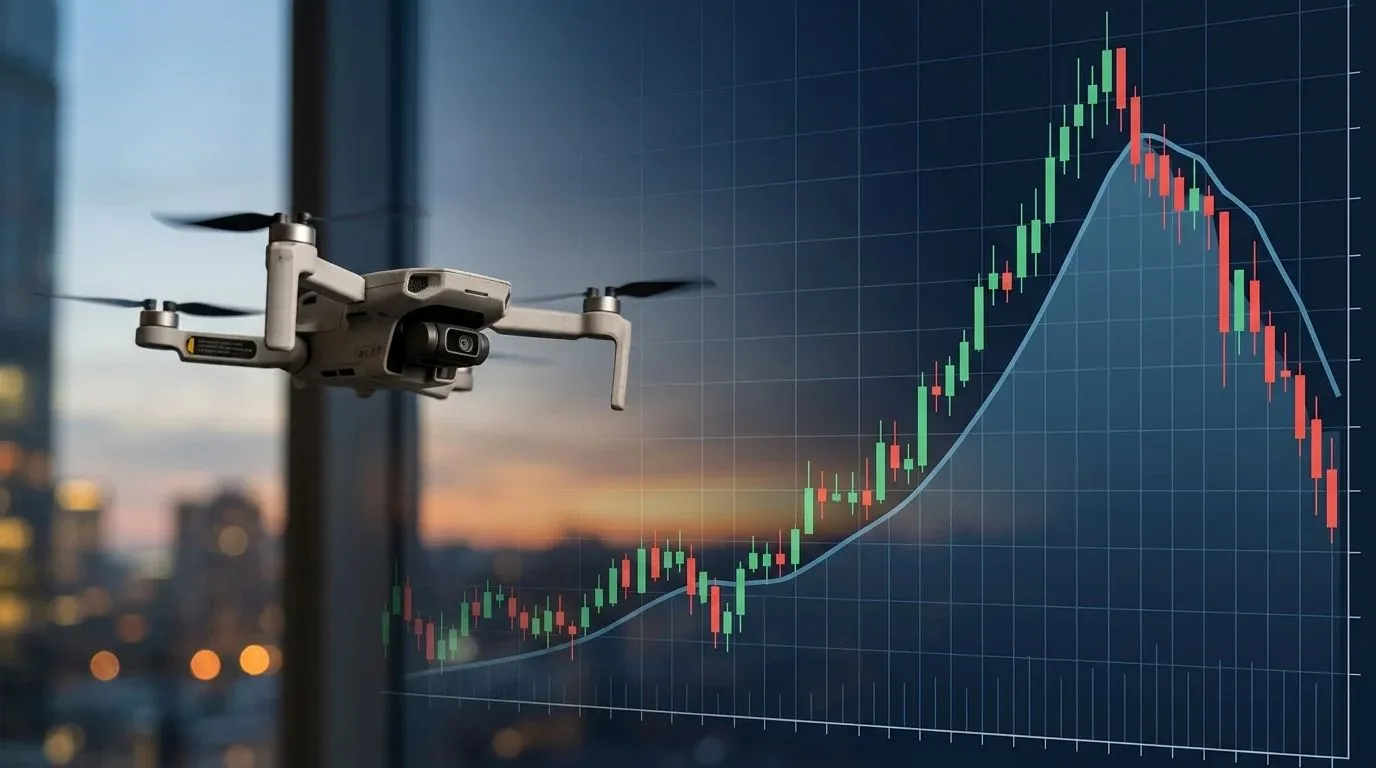
A drone costing a few thousand dollars can now destroy a warship worth hundreds of millions. Felix Prehn, economist and former investment banker, named the top drone stocks a year ago, and the leading pick turned $10,000 into $47,000 at its peak. Interestingly, many investors who were right about the rise of drones still lost money.
Estimated reading time: 8 minutes
Top Drone Stocks Explained By Felix Prehn
Congress just passed the largest defense bill in the history of the United States, with a whole section dedicated to drones, counter drone systems, and AI on the battlefield.
You're about to get a map of where the money is flowing in the drone sector, the three groups every drone company belongs to, and the trap most people fall into when buying drone stocks.
Felix Prehn also collected the institutional research on the drone industry into a free report, available at felixfriends.org/uav.
Key Takeaways
- The biggest mistake with drone stocks is buying because of headlines, not because of money flow.
- Every drone company belongs to one of three groups: builders, brains, or the shield.
- Real examples show $10,000 growing to $47,000, then falling back to $24,000.
- An exit decided before buying separates winners from losers.
- The largest defense bill in US history now funds drones, counter-drones, and AI.
- A learnable system matters more than copying anyone's stock picks

The Biggest Mistake When Buying Drone Stocks
People use news headlines to decide when to buy, and headlines are always late.
By the time a story about drone stocks is exciting enough to reach the news, the big investors are already preparing to sell. You buy the excitement. They sell the excitement to you and collect their profit.
Wall Street works differently. Professional investors don't ask whether the story is good. They ask where the money is flowing today, and where the way out is when the flow stops.
Following the money is a skill with clear rules, and you don't need a finance degree to learn it.
The first rule is knowing which part of the drone industry gets the money first, and which parts get it later. Felix breaks the whole market into three groups.
Three Groups For Every Drone Company
Felix doesn't treat drone technology stocks as one single group. He sees three separate waves of money arriving at different times, and every drone company belongs to one of them.
Wave One: The Builders
When a military panics, the first thing it buys is hardware, and lots of it. So the companies physically making cheap attack drones, plus the parts inside them, get bought first.
Publicly traded names here include AeroVironment (AVAV) and Red Cat Holdings, while some of the most important American drone companies are still private and may become publicly traded later.
Many builder stocks have already dropped hard; Red Cat is down about 60%. The drop is useful because it gives investors time before money flows back in.
Wave Two: The Brains
A hundred drones must think and act as one, so the money moves next to autonomous systems, swarming, and battlefield AI software. Wave two tends to last longer, because software doesn't get blown up and rarely gets replaced. Palantir is the obvious name in wave two.
Wave Three: The Shield
If cheap drones are the new threat, the biggest new market is counter drone technology: the radars and devices detecting a swarm from far away and destroying it cheaply. Whoever can kill a cheap drone cheaply controls an enormous market. A Goldman Sachs report on the counter UAS space included meetings with every single company in it, and parts of it appear in Felix's free report.
Write the three groups down: builders, brains, shield. The group a stock belongs to tells you when investors are likely to put money in and when they're likely to pull it out.
Most people buy in the wrong order, and the wrong order is the trap; the story stays true while the money moves from one group to the next. The next section shows what the trap costs in real dollars.
Real Drone Stock Performance In Dollars
Here's what happened to $10,000 in the drone stocks Felix covered a year ago. His top pick turned $10,000 into $47,000. AeroVironment turned $10,000 into $16,000, and later peaked at a 370% gain.
Now the second half of the story. Investors who got excited, bought, and kept the stocks because someone told them to buy good companies forever. The $47,000 is now about $24,000. The $16,000 in AeroVironment is now about $5,000, meaning $10,000 became $5,000.

The lesson matters more than the gains. You could pick the right sector and the right company, be completely correct about the news, and still end up with less money. A defense stock isn't Coca-Cola, and it isn't 1968. The missing piece in every losing outcome was an exit plan.
Decide Your Exit Before You Buy Drone Stocks
The rule is direct: decide the exit before you ever buy.
Answer two questions in advance. Where do I get out if I'm wrong, and where do I take profit if I'm right? Then follow the rules without feelings; you can even automate them.
One rule is the whole difference between turning $10,000 into $47,000 and turning $10,000 into $5,000. Getting in is easy. The hard half, the half nobody teaches, is whether you sell.
The full framework has three steps:
- Pick the wave, not the stocks. Before buying anything, ask whether a name is a builder, a brain, or a shield stock. The answer tells you what kind of money is flowing, not where the headline is loudest.
- Follow the money the way the professionals do. They're positioned before the headline appears, and they're probably selling while everyone else buys. Where money moves is information you can learn to spot.
- Set the exit first, then follow your rules.
Felix doesn't watch mainstream news for any of it, because the person on screen is probably selling something. He puts his five tickers into the Winston stock app, and every login shows him updated data on each stock price.
So why is all of the drone money moving now? The answer is simple military math which no longer works.
The Largest Defense Bill In US History

For 70 years the way to win a war was simple: spend more money and build bigger, more expensive machines, meaning fighter jets, aircraft carriers, and missiles costing a million dollars per shot. Cheap drones broke the whole strategy.
Here's the math problem worrying every general and every defense investor. An enemy sends a drone costing maybe $1,000. Shooting it down takes an interceptor missile costing over a million. You win the battle, but repeat the exchange a few hundred times and you run out of money faster than the enemy does. Felix calls it asymmetric warfare, and he calls it the single most important idea in modern warfare today.
Some examples:
- Cheap Iranian drones in the Middle East destroyed multi-million dollar US radar systems, exposing a hole in the defenses of the world's most powerful military.
- The US military recently sent a swarm of robot suicide boats, with no humans on board, to attack an enemy naval base, a first in history.
- Congress responded with the biggest defense bill the US has ever passed, funding drones, counter-drone systems, and battlefield AI.
The size of the market is enormous.

Global military spending is about $3 trillion a year; the US is the largest part of it, and even 10% to 30% of it moving toward drones and autonomous systems is a huge shift.
One note on the word "drone": Felix uses UAV too, short for unmanned aerial vehicle, though some now operate on the ground or at sea. He believes the second opportunity in drone stocks will be bigger than the first, and prices are lower now than at the peak. Should you just copy his picks then? No, and he says so himself.
Why A System Beats Copying Stock Picks
People are sometimes right and sometimes wrong, so blindly buying what anyone else buys means you'll only sometimes be lucky.
Felix shares what he buys, but he might not make a video the day he sells, simply because he doesn't publish daily. Copying his entries without his exits leaves you exposed.
He has watched it happen: a pick goes up 500%, and people still lose money because they buy near the peak and end up down 40% or more. The stock was right. The timing, borrowed from headlines, was wrong.
Felix's goal is to teach you the method rather than give you picks. Learn the rules once and you're independent; and you can teach the skill to your children.
If you want the method he uses, he's teaching it live.
Felix Prehn's Free Drone Report And Seminar
Two free resources are available:
- The research report. Felix read the institutional research on the drone sector, including the Goldman Sachs work, and packed it into a free report at felixfriends.org/uav.
- The live seminar. A free two-hour training on Saturday at 9:00 a.m. New York time, at bulletproofportfolio.org, where Felix explains Wall Street's trading system, the one making news headlines irrelevant to your timing. Grab a free ticket, show up live, and bring questions. There's no replay, because you only learn the material properly when you attend live.

The seminar isn't a sales pitch for any stock, and none of the above is investment advice; Felix isn't a financial advisor, and you must reach your conclusions yourself.
Some background on the teacher: Felix used to be an investment banker and now runs Goat Academy, where retired Wall Street mentors teach regular people the exact strategies big institutions use. Over 26,000 people have learned there in six years, and the academy takes no sponsors.
FAQs
Are Drone Stocks A Good Investment For Every Investor?
Felix respects people who prefer not to buy military drone stocks at all. Civilian and commercial uses of drone technology exist, though most of the money is going to defense.
Which Military Drone Stocks Have The Largest Market Cap: Kratos Defense, Northrop Grumman, Or Lockheed Martin?
Felix names AVAV, Red Cat, and Palantir, and doesn't rank companies by market cap. Kratos Defense, Northrop Grumman, and Lockheed Martin aren't part of his breakdown.
Are Drone Pure Play Companies Like Teal Drones Or Ondas Holdings Publicly Traded?
Felix notes some of the most important drone companies remain private. He finds their possible future public listings interesting for investors watching the sector.
Do The Best Drone Stocks Include Loitering Munition Makers Like AeroVironment's Switchblade?
Felix covers AeroVironment as a wave one builder without naming specific products. Builders make small attack drones and the parts inside them.
Do Counter Drone Systems Use Directed Energy, Electronic Warfare, Or Computer Vision?
Felix doesn't list the specific technology inside counter drone systems. He describes their job simply: detect a swarm from far away with sensors and radars, then destroy it cheaply.
Are Drone Stocks To Buy Limited To Aerial Systems, Or Do Manned Fighters Still Matter?
Felix doesn't compare drones with manned fighter jets. He focuses on the shift itself, calling it the biggest change in how wars are fought and funded in 50 years.
Is Buying Drone Stocks Urgent Right Now Given Market Conditions?
Felix believes the market is still early, and he notes the US is in the middle of a conflict, so government buying is urgent for national security. He describes the current price drop as a time for investors to understand the setup before money returns.
Watch Video: Trump Just Opened Up A $1.15 TRILLION Market (Get In Now?)
Video published on July 23, 2026
DISCLAIMER
The content on the website is for informational and educational purposes only. It does not constitute and should not be construed as financial or investment advice or an offer to purchase or sell securities. The content is not personalized or tailored to a specific person or group of persons, nor to their personal investment or financial needs. You should consult a financial adviser or other investment professional authorized to provide investment advice. Investing comes with risks, including the risk of loss. Presentations of trades made by Goat Academy or its personnel are not a guarantee that any investment decision made by a student will be successful. Past performance is not a guarantee of future performance.
Goat Academy content is for educational purposes only and is not financial advice. Investing involves risk, including the possible loss of principal. Always do your own research.